
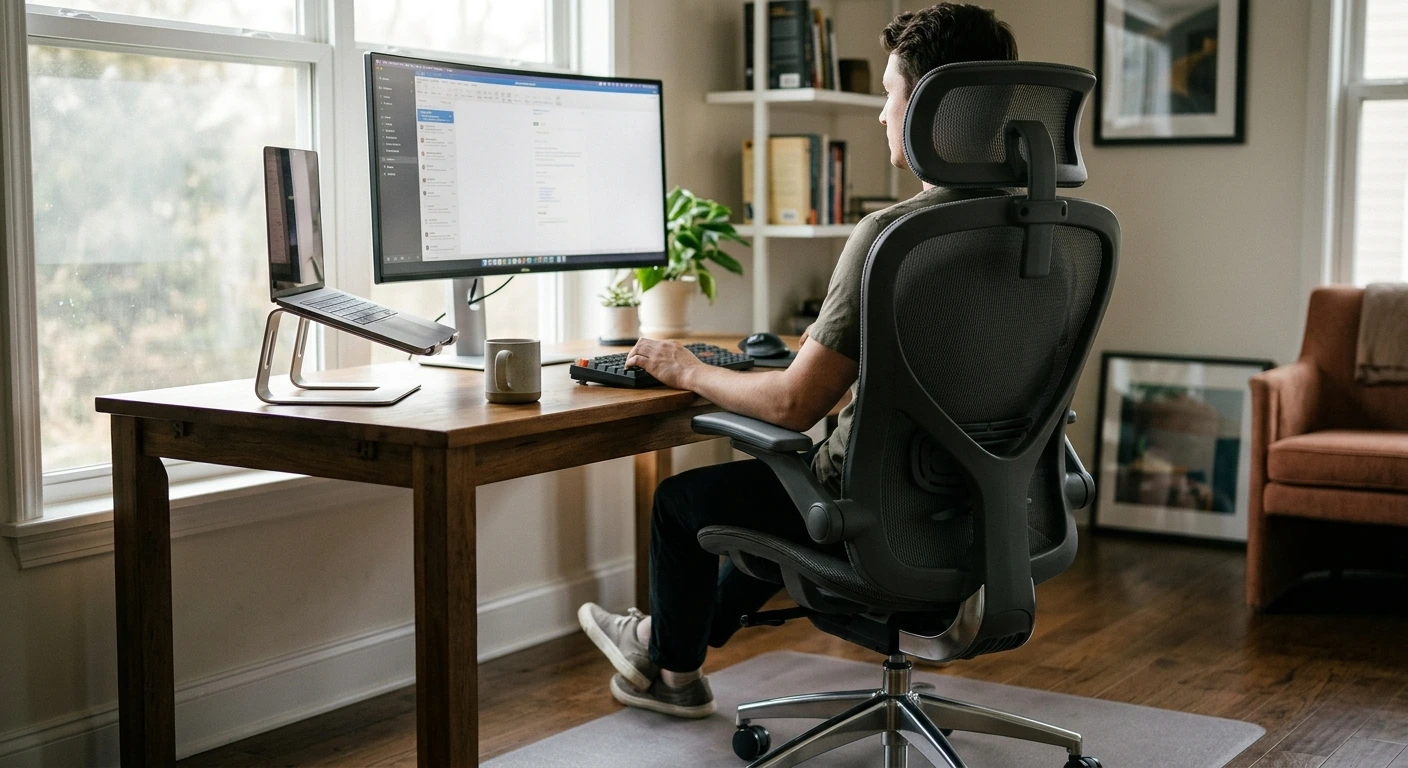

Best budget office chair shopping gets hard fast, because every listing promises all-day comfort for very little money. Some cheap chairs feel great for a month and then sag. Others hold up for years. The trick is to know which features matter and which ones are just nice words. This guide gives you six picks for different needs. You also get a buying checklist, sizing tips, and an honest look at what you give up when you spend less. Read the quick list below if you are short on time.
- Best overall: the high back mesh chair with headrest, flip-up arms and a 90-120° tilt lock (pick 1).
- Best breathable mesh pick for shorter users: the DUMOS Executive chair with a 14.7 to 17.7 inch seat height (pick 2).
- Best leather-look chair: the PU leather chair with a mesh back, adjustable lumbar support and a 300 lb capacity (pick 3).
- Best for long hours and bigger users: the amseatec mesh chair with a 3-inch cushion and a 300 lb capacity (pick 4).
- Best for small spaces: the small armless DUMOS home office chair (pick 5).
- Best no-frills pick: the PayLessHere black office chair with lumbar support (pick 6).
- After the picks, you get a simple guide to lumbar support, seat depth, armrests, wheels, sizing, assembly and how long cheap chairs last.
How we chose these budget office chairs
Shopping for a budget office chair is usually a gamble. Most cheap chairs lead to the same frustrating problems: sore backs, sweaty fabric, armrests that jam under your desk, and parts that break after just a few months.
We wanted to fix that. To save you time and buyers’ remorse, we built a shortlist around what actually matters for long workdays.
Our Selection Criteria
- Workday-Long Comfort: We filtered out flat, rigid chairs. Every pick on our list features built-in lumbar support, a relaxing tilt feature, or a high-density cushion engineered for long hours of sitting.
- A Guaranteed Fit for Your Space: No more guessing if a chair fits your body or your workspace. We specifically looked for models with smooth height adjustments, space-saving flip-up arms, and verified weight ratings up to 300 lbs.
- Real-World Reliability: Instead of relying on a few hours of hands-on testing, we analyzed thousands of data points. Every chair selected is a highly popular, battle-tested budget favorite with a proven track record of durability from real buyers.
Find Your Style
Whether you need a breathable high-back mesh chair for hot afternoons, a sleek leather-look executive chair for video calls, or a compact armless task chair for a tight corner, we’ve found the best value option in every category.
Note: Amazon prices change frequently based on deals and stock. Click to check current prices and availability on Amazon before you buy!
The six budget office chair picks compared
Here is the short version before you dive in. Pick 1 is the safest all-round choice. Pick 4 is the one for long days and bigger frames. Pick 3 is for people who want a leather look. Picks 5 and 6 are for tight spaces and tight budgets.
Think of this section as your comparison list. Each pick gets a clear “who it suits” note, plus pros and cons. You will not find made-up specs here. If a chair has a stated weight capacity or seat height, you will see it. If not, the write-up focuses on what the chair does well.
One more thing before the picks. A cheap chair is not a bad chair. It just has less room for error. That is why the fit matters so much more than the brand name on the box.
1. Best overall: high back mesh chair with headrest
This is the chair to grab if you want the most features in one budget package. It has a high back, a headrest, flip-up arms and a 90-120° tilt lock. The maker says it gives four support points: head, back, hips and hands. It suits people who work long days and want neck support without paying for a premium chair.
It’s a big and tall chair, and the maker says the mesh seat is larger than other chairs to fit different body builds. The mesh back and mesh seat both let air move, which helps if you run warm. You can fold the arms up 45° and push the chair right under your desk. It also comes with a 3 year warranty, which is a nice safety net on a cheap chair.
Pros
- Headrest and high back support your neck and upper back
- Mesh seat and mesh back keep air moving
- Arms flip up 45° so the chair slides under the desk
- 90-120° tilt lock for leaning back on breaks
- 3 year warranty
Cons
- Mesh seats feel firmer than thick foam to some people
- Budget headrests do not line up perfectly for every height
- A wide, high back chair takes more floor space
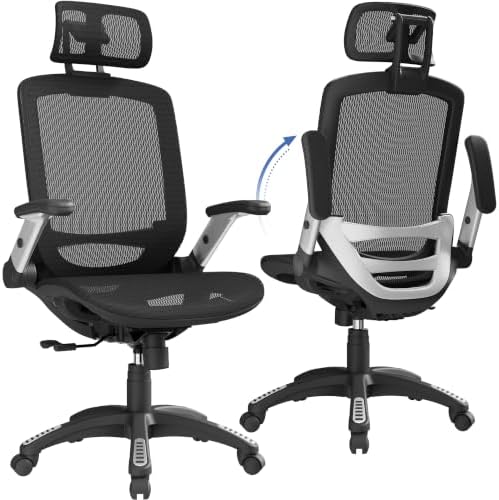
- 【ERGONOMIC OFFICE CHAIR】- The ergonomic chair provides 4 supporting points(head/ back/ hips/ hands) and a proper lumbar …
- 【COMFORTABLE MESH SEAT】- The office chair is larger than other chairs, and it could accommodate different body build. Th…
- 【ADJUSTABLE FLIP-UP ARMREST】- Folding the armrests up 45°, you can push the executive office chairs directly under the d…
- 【BREATHABLE MESH CHAIR】- The mesh back and mesh seat keep air circulation for extra comfy. High quality mesh resists abr…
- 【3 YEARS WARRANTY & EASY INSTALLATION】- All ergonomic office chairs come with 3 years warranty, so please email us direc…
2. Best breathable mesh pick for shorter users: DUMOS Executive chair
This DUMOS chair suits shorter and average-height people who want a cool, clean-looking chair. The seat height goes from 14.7 to 17.7 inches. That lower range helps shorter folks keep their feet flat on the floor at a normal desk. If you often feel like your feet dangle, this chair is worth a close look.
It has a contoured mid-back and lumbar support shaped to fit your spine. The 90°-120° tilt lets you rock back on breaks, and a tension knob sets how easy it rocks. The maker says the metal base is reinforced and the casters roll quietly. The breathable mesh also makes it a solid choice if you get sweaty in a padded chair.
Pros
- Seat height of 14.7 to 17.7 inches fits shorter users well
- Contoured lumbar support for the lower back
- 90°-120° rocking tilt with a tension knob
- Metal base and quiet casters
- Breathable mesh for warm rooms
Cons
- Tall people may find the top seat height too low
- A fixed back curve fits some spines better than others
- Mesh can feel less cozy than padding in a cold room

- 𝐄𝐫𝐠𝐨𝐧𝐨𝐦𝐢𝐜 𝐋𝐮𝐦𝐛𝐚𝐫 𝐒𝐮𝐩𝐩𝐨𝐫𝐭: Contoured mid-back and lumbar support in our DUMOS office chair fit your spine to ease back an…
- 𝐇𝐞𝐢𝐠𝐡𝐭 𝐀𝐝𝐣𝐮𝐬𝐭𝐚𝐛𝐥𝐞: Adjust seat height from 14.7 to 17.7 inches on this DUMOS desk chair to suit different body types, fi…
- 𝐑𝐨𝐜𝐤𝐢𝐧𝐠 𝐑𝐞𝐜𝐥𝐢𝐧𝐞 𝐌𝐨𝐝𝐞: Engage the 90°-120° tilt mechanism on the DUMOS Executive chair for relaxing breaks, tension knob …
- 𝐒𝐭𝐮𝐫𝐝𝐲 𝐒𝐢𝐥𝐞𝐧𝐭 𝐌𝐨𝐯𝐞𝐦𝐞𝐧𝐭: Reinforced metal base and smooth-rolling silent casters ensure stable quiet mobility, chair whee…
- 𝐌𝐨𝐝𝐞𝐫𝐧 𝐀𝐞𝐬𝐭𝐡𝐞𝐭𝐢𝐜 & 𝐏𝐫𝐚𝐜𝐭𝐢𝐜𝐚𝐥 𝐃𝐞𝐬𝐢𝐠𝐧: Sleek modern silhouette with breathable mesh and finish complements any interior st…
3. Best leather-look chair: PU leather chair with adjustable lumbar
Pick this one if you want a chair that looks more like an executive seat. It pairs a PU leather seat with a mesh back, so you get a classic look and some airflow behind you. It suits people who like a soft seat and want lumbar support they can move up and down. It also works well in a home office that doubles as a guest room or meeting space.
The maker says the thick sponge cushion is quite soft. The back has an S-shaped curve to follow your spine. The maker also says it passed SGS certification and a BIFMA test, with a maximum capacity of 300 lbs. The flip-up arms help it tuck under a desk, and all the parts, screws and a wrench come in the box.
Pros
- Lumbar support adjusts up and down
- Soft, thick sponge cushion
- Maximum capacity of 300 lbs
- Mesh back helps cool your back
- Flip-up arms save space
Cons
- PU leather seats can feel warm on hot days
- Soft budget foam tends to flatten over time
- PU leather can crack or peel after a few years of heavy use

- 【Super Comfortable Office Chair】The thickened sponge seat cushion is quite soft and highly resilient, making it suitable…
- 【Ergonomic Design】The S-shaped curve of the chair fits the spine of the human waist and back well, improving the sitting…
- 【Adjustable Comfort】Equipped with a lumbar support that can be adjusted up and down, adding support can help you focus o…
- 【Sturdy and Space-saving】This chair passed SGS certification and BIFMA test, maximum capacity is up to 300 lbs. The 3-st…
- 【Easy to Assemble】All the parts, screws and wrench needed to install the chair are in the box. Following the detailed in…
4. Best for long hours and bigger users: amseatec mesh chair
This amseatec chair is the pick for long workdays and for bigger frames. The maker rates it to support up to 300 lbs. It suits people who sit for six to eight hours and want a thicker seat than a thin mesh chair gives. It also suits small rooms, thanks to the flip-up arms.
The seat has a thick 3-inch high-density cushion, and the back is breathable mesh. That combo gives you a padded seat and a cooler back. You get a 90–110° rocking tilt with tension control and easy height adjustment. The maker calls the frame aerospace-grade plastic and says assembly takes about 15 minutes with the tools included. It also comes with a warranty.
Pros
- Supports up to 300 lbs
- Thick 3-inch high-density seat cushion
- Breathable mesh back
- 90–110° rocking tilt with tension control
- Flip-up arms and quick assembly
Cons
- The 90–110° tilt is a smaller range than 120° chairs
- Some buyers prefer a metal frame over plastic
- Mid-back chairs give less neck support than high back models

- Strong & Certified Quality: The aerospace-grade plastic frame safely supports up to 300 lbs , ensuring superior durabili…
- Space-Saving Flip-Up Armrests: Flip-up armrests let you slide the chair under your desk easily, ideal for small spaces l…
- All-Day Comfortable Seating: A breathable mesh back and thick 3-inch high-density seat cushion supported by a solid coat…
- Adjustable for Personalized Comfort: Features include a 90–110° rocking tilt with tension control, effortless height adj…
- Easy Assembly & Trusted Warranty: Quick 15-minute assembly with included tools, plus enjoy factory-direct savings, an in…
5. Best for small spaces: DUMOS armless home office chair
This small armless DUMOS chair suits tiny home offices, bedroom desks and dorm-style setups. With no arms, it slides fully under a desk and out of the way. It suits people who move around a lot, sit cross-legged, or share a desk with a kid. It is also a good fit for a craft table or a second workspace.
Lumbar support is listed, so your lower back still gets some help. The chair has a 360° swivel and a height-adjustable seat. The maker says all the needed parts come in the box. It is a simple chair, and that is the point. Fewer parts often means fewer things to break or wobble.
Pros
- Armless design tucks fully under the desk
- Small size fits tight rooms
- Lumbar support for the lower back
- 360° swivel and height adjustment
- Fewer moving parts to wear out
Cons
- No arms, so your elbows get no rest
- A small seat may feel tight for bigger frames
- Simple task chairs offer fewer ways to fine-tune fit

- Space Saving Design: This small armless office chair is designed with space-saving features in mind. The height-adjustab…
- Premium Materials: This small office chair without armrest is constructed by top-notch materials to guarantee maximum co…
- Enhanced Ergonomic: This armless office chair is ergonomically designed for optimal comfort and support. The backrest is…
- Sturdy and Durable: This 360° swivel task chair is built to withstand long hours of use, featuring a high-quality metal …
- Easy Installation: All the necessary accessories are included in the package, ensuring a seamless assembly experience. S…
6. Best no-frills pick: PayLessHere black office chair
This PayLessHere chair is for people who want a plain black chair with lumbar support and nothing fancy. It suits a first apartment, a spare desk, or anyone who works part-time from home. It also works as a backup chair for a second office or a guest who stays a while. If you just need something better than a kitchen chair, start here.
It has built-in lumbar support and tension control for comfort. The maker says the ergonomic design helps with good posture. It fits offices, home work spaces and other everyday spots. The look is simple, so it blends in with most desks and rooms.
Pros
- Built-in lumbar support
- Tension control for a comfortable feel
- Plain black look fits most rooms
- Works for home offices and regular offices
Cons
- Basic chairs give fewer ways to adjust fit than high back models
- Better for part-time use than very long daily sessions
- Budget padding tends to flatten with daily use

- Comfort and Tension Control: Our office chair provides reliable comfort with its ergonomic design and high-quality mater…
- Ergonomic Design: Our office chair features an ergonomic design. This innovative design promotes proper posture and redu…
- Lumbar Support: Experience optimal back support with the built-in lumbar support feature on this computer chair. The adj…
- Suitable for Various Occasions: This versatile office chair is suitable for various occasions, including offices, home w…
- Sturdy and Durable Construction: Constructed with high-quality materials, this computer chair is designed to withstand d…
What to look for in a budget desk chair
The best budget office chair is the one that fits your body and your desk. A chair with ten features that does not fit will hurt more than a plain chair that does. Use these points to judge any cheap chair, including ones not on this list.
Lumbar support
Your lower back curves inward. A good chair fills that curve so you do not slump. Some chairs have a fixed curve in the back. Others have a pad you can slide up and down, like pick 3. Adjustable is better if you are very short or very tall, because a fixed curve may hit the wrong spot. If lower back pain is your main worry, our guide to the best office chair for lower back support goes deeper.
Seat height
Most desks sit around 29 to 30 inches tall. At that height, most people need a seat that lands somewhere between 16 and 21 inches. Sit with your feet flat and your knees at about hip level. Your elbows should rest near desk height. If you are short, a lower seat range like the 14.7 to 17.7 inches on pick 2 helps. If you are tall, look for a higher top height or raise your desk.
Seat depth and width
Seat depth is how far the seat goes from front to back. Sit all the way back. You want about two to four fingers of space between the seat edge and the back of your knees. Too deep, and the edge presses your legs. Too shallow, and your thighs get no support. Wider seats, like the big and tall style on pick 1, suit broader hips.
Armrests
Armrests should let your shoulders relax. If they push your shoulders up, they are too high. Flip-up arms are great for small spaces, since you can fold them and push the chair under the desk. Cheap armrests do wobble a bit over time, though. If you rest your full weight on them to stand up, they wear faster.
Tilt and recline
A tilt lets you lean back and shift your weight. That small movement is good for your back over a long day. A range of 90 to 120 degrees is common. Look for a tension knob so the chair does not tip back too easily.
Wheels and base
Casters take a beating. Hard floors and carpet need different wheels. Standard plastic casters roll well on carpet but can scratch wood floors. If you have hardwood, add a chair mat or swap to soft rubber wheels later. A metal base usually feels sturdier than plastic, though many plastic bases hold up fine.
Weight capacity
Pick a chair rated at least 50 lbs above your body weight. That buffer helps the gas lift, base and seat last longer. Picks 3 and 4 both list a 300 lb capacity, which covers most adults with room to spare.
Mesh vs PU leather vs foam for long hours
This is the question most buyers get stuck on. Each material has a clear trade-off, so match it to how you work and how warm your room gets.
Mesh breathes best. Air moves through the back and seat, so you stay cool. It is the clear winner for warm rooms, summer months and people who sweat easily. Mesh seats feel firmer at first. Some people love that, and some miss the cushy feel. Picks 1 and 2 lean hard into mesh.
PU leather looks smart and wipes clean in seconds. It feels soft and cozy. The downside is heat. PU leather traps warmth, and after a few hours you may feel sticky. It also tends to crack or peel after a few years of daily use. A mix of a PU leather seat and a mesh back, like pick 3, gives you a bit of both.
Foam cushions under fabric feel the most comfortable on day one. A thick, high-density cushion, like the 3-inch seat on pick 4, holds its shape longer than thin, soft foam. Cheap soft foam flattens first. You notice it when you start feeling the seat pan under you.
Quick rule: if you run hot, choose mesh. If you want soft and easy to clean, choose PU leather. If you sit eight hours a day, choose a thick, dense cushion with a mesh back.
What you give up with a cheap office chair and when to spend more
Budget chairs are a great deal for most people. But you should know where the savings come from. Here is what usually gets cut, and which parts tend to fail first.
- The foam flattens. Budget foam is lighter and less dense. After a year or two of daily use, it compresses. A seat cushion can buy you time when that happens.
- Armrests start to wobble. Cheap arms use plastic joints and small screws. Tighten them every few months to keep the wobble down.
- The gas lift sinks. The gas cylinder lets the seat go up and down. On cheap chairs, it can slowly sink after a few years. The good news is that a replacement cylinder is easy to swap.
- Casters crack or stick. Hair and dust wrap around the wheels. Clean them now and then. Replacement casters are cheap and pop right in.
- Fewer adjustments. Pricier chairs adjust seat depth, arm height, arm width and lumbar depth. Budget chairs usually adjust height and tilt, and maybe the lumbar.
So when should you spend more? Spend more if you have a known back problem, sit more than eight hours a day, or are very tall or very short. In those cases, extra adjustments are worth the money. A cheap chair you replace every year well-fitted chair that lasts saves cash in the long run. For everyone else, a smart budget pick does the job just fine.
Also think about your whole setup, not just the chair. A good chair at the wrong desk still hurts. Pairing your chair with an ergonomic standing desk lets you switch between sitting and standing. That takes a lot of pressure off a cheap seat. If you work on a laptop, a stand that lifts the screen to eye level helps your neck, too. Our list of the best laptop stands for home office setups is a good next step.
Quick assembly and sizing tips
Most budget chairs arrive flat in a box. You do not need special skills to put them together. Plan for about 15 to 30 minutes for a simple chair. The maker of pick 4 says about 15 minutes with the included tools. High back chairs with headrests take a little longer.
- Open the box near where the chair will live. It saves you carrying a bulky chair through the house.
- Lay out every part and count the screws before you start.
- Attach the casters to the base first. They push in with firm pressure.
- Drop the gas lift into the center of the base.
- Attach the seat plate and arms to the seat, then the backrest.
- Set the seat on the gas lift and sit down to lock it in place.
- Tighten every screw again after a week of use. Screws settle as the chair breaks in.
Now size it to your body. Raise or lower the seat until your feet sit flat and your knees are about level with your hips. Slide back so your lower back touches the lumbar support. Set the armrests so your shoulders stay loose. Then check your screen. The top of the screen should sit near eye level.
Check your desk height too. If your desk is too tall for your chair, your shoulders creep up. If it is too low, you hunch. A desk with drawers can also free up space around your chair. See our picks for an office desk with drawers if you need more storage.
Pre-purchase checklist for a cheap office chair
Run through this list before you click buy. It takes two minutes and saves you a return.
- Measure your desk height and the space under it.
- Check the chair’s seat height range against your leg length.
- Pick a weight capacity at least 50 lbs above your weight.
- Choose mesh if you run hot, PU leather if you want easy cleaning.
- Decide if you need arms, flip-up arms, or no arms at all.
- Look for lumbar support, and adjustable lumbar if you are very short or tall.
- Check the warranty length, like the 3 years on pick 1.
- Know the return window and keep the box until you are sure.
That last point matters more than people think. Sit in your new chair for a full workday within the first week. Pay attention to your lower back, your thighs and your shoulders. If something hurts, adjust first. If it still hurts, return it while you can. Keeping the box for two weeks is the cheapest insurance you will ever buy.
FAQs
How much should I spend on a good budget office chair?
Think in two tiers. Entry-level chairs give you the basics: height adjustment, a swivel, simple lumbar support and maybe a tilt. These suit part-time use and small spaces. Mid-range chairs usually give you more: a higher back, a headrest, flip-up arms, thicker cushions, wider tilt ranges and higher weight ratings. If you work from home full-time, a good mid-range office chair is often a much better daily experience than a bare-bones one. Check the current price on Amazon for each pick, since prices shift often.
Is a cheap mesh chair or a PU leather chair better for long hours?
For most people, mesh wins for long hours. It stays cool and does not get sticky. PU leather feels soft but traps heat and can wear out faster. A mix works well too: a padded seat with a mesh back, like picks 3 and 4, gives comfort under you and airflow behind you.
Are budget ergonomic chairs actually good for back pain?
They can help, as long as they fit you. Lumbar support, the right seat height and a tilt that lets you move all ease strain. A budget ergonomic chair will not fix a medical problem, though. If you have ongoing back pain, talk to a doctor or physical therapist. Also take breaks. Standing up every 30 to 60 minutes helps more than any chair.
How long does a cheap office chair last?
Expect about two to four years of daily use from most cheap chairs. Light use can stretch that longer. The first parts to go are usually the foam, the armrests, the gas lift and the casters. The good news is that casters and gas lifts are easy to replace. Tighten screws every few months and keep the wheels clean to get more life out of it.
What weight capacity should I look for in a budget chair?
Aim for at least 50 lbs above your body weight. Many budget chairs land around 250 lbs. If you weigh more than 200 lbs, look for a 300 lb rating, like picks 3 and 4. A big and tall style seat, like pick 1, also gives you more room to sit.
Is a gaming chair a good budget office chair?
Sometimes, but not always. Gaming chairs look bold and often recline far. Many use PU leather, which gets warm, and their bucket seats can feel narrow. Some have pillows instead of real lumbar support. For a home office, a mesh or padded task chair usually fits better and looks calmer. If you love the gaming look, just check the seat size and lumbar support closely.
Which pick is the best cheap ergonomic office chair for most people?
Pick 1 is the safest bet for most home office workers. It has a headrest, a high back, a mesh seat and back, flip-up arms and a 3 year warranty. If you sit very long hours or need a 300 lb rating, go with pick 4. If you are short, pick 2 is a strong match.
Final word
The best budget office chair is the one that fits your body, your desk and the way you work. For most people, pick 1 gives the most support for the money, with a headrest, all-mesh comfort and a 3 year warranty. Choose pick 4 for long days and bigger frames, pick 2 if you are on the shorter side, and pick 3 if you want a leather look. Picks 5 and 6 cover tight rooms and simple needs. Measure your desk, check the seat height and weight rating, keep the box for a couple of weeks, and you will end up with a chair that feels good every workday.
About the author: Connect on LinkedIn