
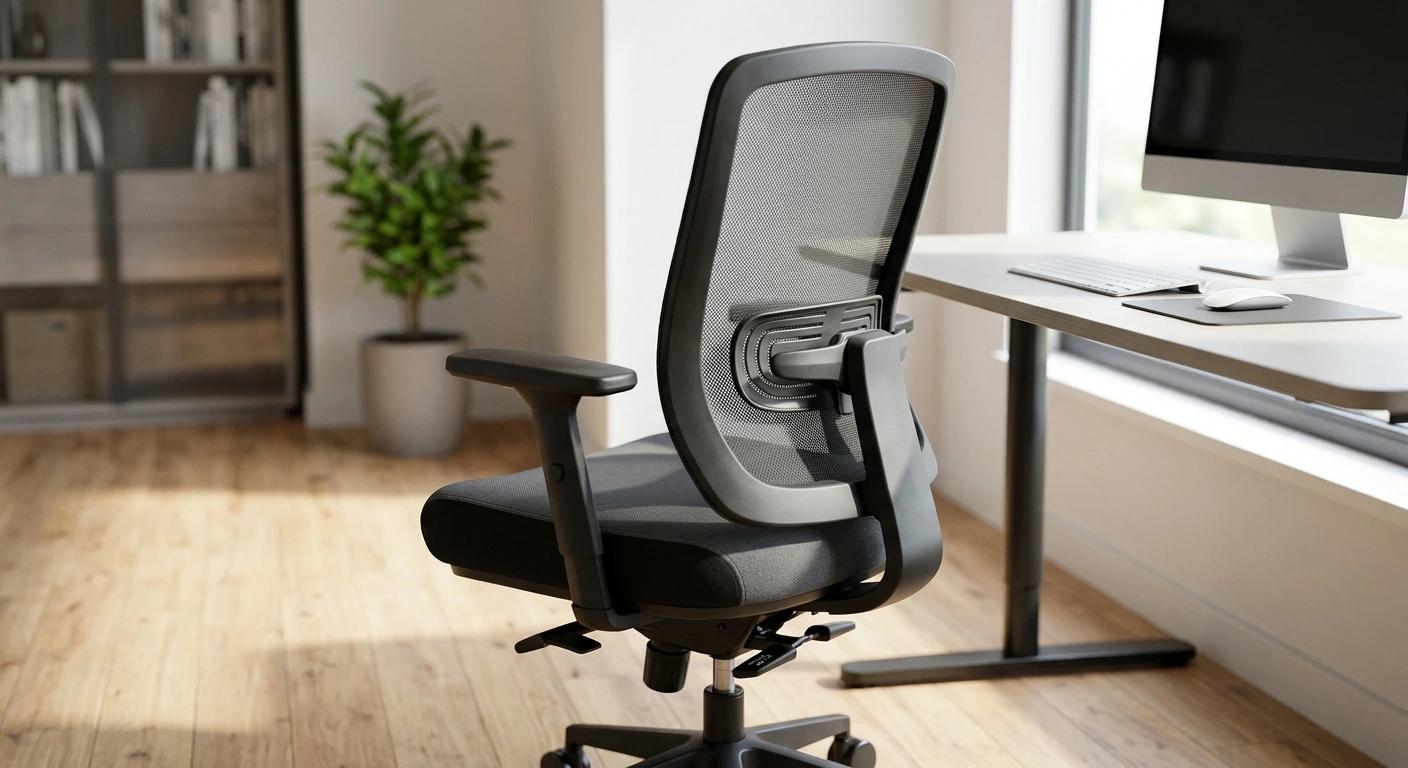

Best office chair for lower back support searches usually start the same way: your back aches by mid-afternoon, and you are tired of it. Most top lists push designer chairs that cost as much as a used car. That doesn’t help most people. This guide sticks to chairs you can buy on Amazon. It explains lumbar features in plain words, so you know what you are paying for. You will also learn how to set up your chair, when a lumbar pillow is enough, and when back pain needs a doctor instead of new furniture.
- Five Amazon chairs, each matched to a real situation: overall lumbar relief, a certified pick, mesh with a headrest, high back for long hours, and big and tall.
- A plain guide to lumbar height, depth, 4-way adjustment, and tilt.
- How to spot cheap chairs with fake lumbar features, plus what BIFMA certification means.
- When a lumbar pillow beats buying a new chair.
- A step-by-step setup guide and a quick fit checklist.
- Answers to common questions, including when to see a doctor or physical therapist.
Quick Picks: Best Office Chairs for Lower Back Support at a Glance
Short on time? Here is the shortlist. Each chair gets a full write-up further down, with pros and cons.
- Best overall for lower back relief: Ergonomic Office Chair for Lower Back Relief with 4-way lumbar and a 330 lb rating.
- Best certified pick: Ergonomic Mesh Office Chair with BIFMA X5.1 certification and adjustable lumbar support.
- Best mesh chair with a headrest: Mesh Office Chair with Headrest, Lumbar Support, 3D Arms, and Wide Seat.
- Best high back for long hours: High Back Ergonomic Chair with headrest, flip-up arms, and a 90 to 120 degree tilt lock.
- Best for big and tall users: 500 lb Big and Tall Office Chair with adjustable lumbar support and an extra wide seat.
Prices change often, so check the current price on Amazon for each one. Then read the feature guide below before you buy. It will save you from a chair that looks supportive but isn’t.
How We Chose These Chairs for Lower Back Support
We know how frustrating it is to find an office chair that actually relieves lower back pain. To save you hours of guesswork, we conducted a rigorous, specification-first screening of hundreds of listings. Instead of relying on subjective “one-size-fits-all” comfort tests, we analyzed exact engineering data to match chairs with proven ergonomic principles.
Here is the strict checklist a chair had to pass to make our list:
- Verifiable Lower Back Support: We skipped chairs that merely claim to be “ergonomic.” Every pick must explicitly feature targeted lumbar support, a high-back design, or an advanced tilt-lock mechanism to keep your spine aligned during long hours.
- Precision Adjustability: We heavily favored chairs listing exact mechanical adjustments—such as 4-way lumbar tracking, 3D/4D armrests, or multi-angle synchro-tilt. The more control you have, the better you can tailor the chair to your pain points.
- True Size & Weight Inclusivity: Back pain doesn’t care about your clothing size. We curated a diverse lineup built for real bodies, spanning from standard builds up to heavy-duty 500 lb weight capacities.
- Verified Durability Standards: We gave massive bonus points to chairs with independent BIFMA certification listed right upfront. This guarantees the chair has been laboratory-tested for commercial-grade safety and longevity.
The Golden Rule of Ergonomics: Fit is Everything.
A chair that feels like a dream for someone who is 5’4″ can cause severe back strain for someone who is 6’3″. Because there is no single “absolute best” chair for everyone, we have sorted our top picks by specific body types and sitting situations.
Find your exact profile below to discover your perfect ergonomic match!
What Lumbar Support Features Actually Matter
Your lower spine has a natural inward curve. Doctors call it the lumbar curve. When you sit for hours, that curve tends to flatten. Your pelvis tips back, you slump, and the muscles in your lower back work overtime. Good lumbar support fills the gap between your back and the chair. It helps hold that curve without you thinking about it.
Not all lumbar support works the same way. Here is what the common terms mean.
Fixed Lumbar Support
Fixed lumbar is a bump built into the backrest. You can’t move it. If it lines up with your lower back, great. If it doesn’t, it can push on the wrong spot. Fixed lumbar works best for people of average height. Taller and shorter people often find it sits too high or too low.
Adjustable Lumbar Height
This lets you slide the support up or down. That matters because everyone’s lumbar curve sits at a different spot. Height adjustment is the single most useful lumbar feature. If you only get one adjustment, make it this one.
Adjustable Lumbar Depth
Depth controls how far the support pushes forward into your back. Some people need a firm push. Others want a gentle touch. Without depth control, the support may feel like a fist in your spine, or you might barely feel it at all.
4-Way Lumbar Adjustment
A 4-way system combines both. You can move the support up, down, in, and out. This gives you the best chance of a good fit, especially if you share the chair or your body is outside average height. If your back pain is your main reason for buying, 4-way lumbar is worth seeking out.
Tilt and Recline
People forget about tilt. But leaning back a little takes pressure off your lower spine. Sitting bolt upright at 90 degrees all day is harder on your back than a slight recline. A tilt lock lets you hold a comfy angle. Tension control lets you set how hard you have to push to lean back.
Seat Depth and Seat Width
Seat depth matters more than most people think. If the seat is too deep, you can’t reach the backrest without your knees getting jammed. So you perch on the edge, and the lumbar support does nothing. If the seat is too shallow, your thighs lack support. Aim for two to four finger widths between the seat edge and the back of your knees.
How to Spot Fake Lumbar Features
Cheap chairs often use the word “lumbar” loosely. Watch out for these red flags:
- A soft curve sewn into a padded back, with no way to move it.
- A small pillow strapped on with elastic that slides down as you sit.
- Photos that show a lumbar part but a description that never says it adjusts.
- “Ergonomic” in the description, with no list of real adjustments.
Here is a myth worth dropping: Any chair with a curved back has lumbar support. A curved back is just a shape. Real support sits at the right height and pushes at the right depth for your body.
What BIFMA Certification Means
BIFMA is a group that sets testing standards for office furniture in the US. A chair that meets the BIFMA X5.1 standard has passed tests for strength, stability, and durability. It does not prove a chair is comfy or good for your back. But it does tell you the chair was built to hold up to daily use. That’s a solid sign when you are buying online and can’t sit in the chair first.
Best Overall: Ergonomic Office Chair for Lower Back Relief with 4-Way Lumbar
1. Ergonomic Office Chair for Lower Back Relief, 4-Way Lumbar, 330 LBS
This chair puts lower back relief right in its name, and it backs that up with 4-way lumbar adjustment. That means you can move the support up, down, in, and out to match your curve. It suits people whose main problem is a stiff or aching lower back after long desk days. It also works well if more than one person in your home uses the chair, since 4-way lumbar adapts to different backs. With a 330 lb rating, it covers most average and larger builds.
Pros
- 4-way lumbar lets you adjust both height and depth.
- Built with lower back relief as the main goal.
- 330 lb weight rating covers a wide range of users.
- Good choice for shared home offices.
Cons
- The arm mechanism is stiff and cumbersome to adjust up and down.
- Users over 330 lbs should look at the big and tall pick instead.

- 【All-Day Comfort for Long Hours】Designed to keep you comfortable through long hours of work, study, or daily tasks, this…
- 【Relieve Back Pressure & Support Better Posture】The adjustable lumbar support follows the natural curve of your spine to…
- 【Personalized Comfort with Easy Adjustments】Customize your seating experience with an adjustable headrest, lumbar suppor…
- 【Breathable Support for Comfortable Sitting】The breathable mesh back promotes airflow to help reduce heat buildup during…
- 【Built Strong for Years of Use】Engineered for everyday reliability, this heavy-duty office chair supports up to 330 lbs …
Best Certified Pick: BIFMA X5.1 Mesh Chair with Adjustable Lumbar
2. Ergonomic Mesh Office Chair, BIFMA X5.1 Certified, Adjustable Lumbar Support
This is the only chair on our list that names BIFMA X5.1 certification in it. That makes it a smart pick if you want proof the frame was built to last. It suits people who work long hours at a home or company desk and want a breathable mesh back with adjustable lumbar support. The 3D arms, tilt back, and wide seat make it a good fit for people who like to fine-tune their setup. If durability worries you when buying online, start here.
Pros
- BIFMA X5.1 certified for strength and durability.
- Adjustable lumbar support helps match your lower back.
- 3D arms move in several directions for better shoulder comfort.
- Tilt back lets you recline to ease spine pressure.
- Mesh back breathes well during long sessions.
Cons
- Can spin if inadvertently bumped during daily use.
- Mesh can feel firm at first if you are used to padded chairs.

- 【Adjustable Lumbar Support】- The lumbar support of MOLENTS office chair can be adjusted up and down, forward and backwar…
- 【Adjustable 3D Armrests】- MOLENTS ergonomic office chair with 3D adjustable armrests offer tailored support for your arm…
- 【Breathable and Comfortable Mesh Office Chair】- This computer chair is crafted from premium breathable and high elastic …
- 【Tilt Back 90°-120°】- With a backrest that has three reclining positions from 90° to 120°, MOLENTS ergonomic chair allow…
- 【Ergonomic Desk Chair】- Ergonomically designed to conform to the body’s curves and pressure distribution, MOLENTS office…
Best Mesh Chair with a Headrest
3. Mesh Office Chair with Headrest, Lumbar Support, 3D Arms, Wide Seat
This chair covers the basics that most desk workers need: a mesh back, built-in lumbar support, a headrest, 3D arms, and a wide seat. It suits people who get both lower back and neck tension during the day. A headrest helps when you lean back to read, take calls, or think. It’s a good match for someone who wants a full-support chair with a simple feature list.
Pros
- Headrest supports your neck when you recline.
- Lumbar support is built into the design.
- 3D arms help keep your shoulders relaxed.
- Wide seat gives room to shift positions.
- Mesh keeps air moving on warm days.
Cons
- Fixed lumbar may not line up well for very tall or very short users.

- LONG-HOUR ERGONOMIC COMFORT: Designed for comfortable work and study, this ergonomic office chair combines an adjustable…
- BREATHABLE MESH & WIDE SEAT: The breathable mesh back promotes airflow to help reduce heat buildup during long work sess…
- PERSONALIZED ADJUSTMENTS: Fine-tune your sitting position with a 2.96-inch seat-height range, adjustable headrest and 3D…
- BUILT FOR EVERYDAY USE: A reinforced five-star metal base, SGS-certified gas lift and smooth-rolling casters provide dep…
- EASY TO ASSEMBLE, READY FOR WORK: Clear instructions and included hardware make setup straightforward. With a 120° recli…
Best High Back Chair for Long Hours
4. High Back Ergonomic Office Chair with Headrest, Flip-Up Arms, 90-120° Tilt Lock
If you sit for eight hours or more, this is a strong option among high back office chairs. The high back and headrest support your whole spine, from hips to neck. The 90 to 120 degree tilt lock lets you hold a relaxed recline, which takes load off your lower back. Flip-up arms let you pull close to your desk or sit cross-legged. The title also lists it as a big and tall mesh chair with a wide cushion and recycled materials.
Pros
- High back and headrest support the full length of your spine.
- Tilt lock from 90 to 120 degrees lets you hold a comfy recline.
- Flip-up arms tuck away so you can get closer to your desk.
- Wide cushion and big and tall design give room to move.
- Made with materials under the Global Recycled Standard.
Cons
- Flip-up arms may not adjust in height.
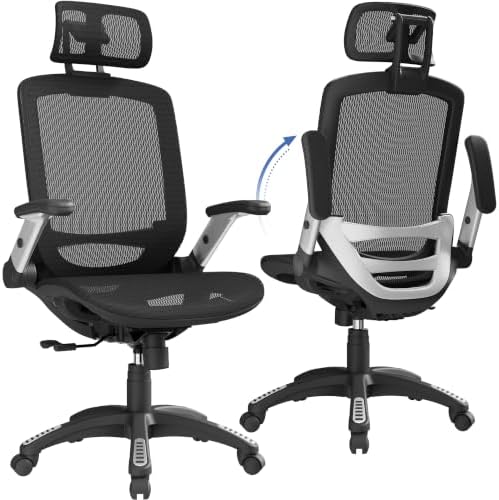
- 【ERGONOMIC OFFICE CHAIR】- The ergonomic chair provides 4 supporting points(head/ back/ hips/ hands) and a proper lumbar …
- 【COMFORTABLE MESH SEAT】- The office chair is larger than other chairs, and it could accommodate different body build. Th…
- 【ADJUSTABLE FLIP-UP ARMREST】- Folding the armrests up 45°, you can push the executive office chairs directly under the d…
- 【BREATHABLE MESH CHAIR】- The mesh back and mesh seat keep air circulation for extra comfy. High quality mesh resists abr…
- 【3 YEARS WARRANTY & EASY INSTALLATION】- All ergonomic office chairs come with 3 years warranty, so please email us direc…
Tip: if you love this chair’s recline but want more lower back help, pair it with a lumbar pillow. More on that below.
Best for Big and Tall Users
5. 500lbs Big and Tall Office Chair with Adjustable Lumbar Support
Big and tall users with back pain get left out of most chair guides. This one is built for them. It has a 500 lb rating, adjustable lumbar support, and an extra wide seat. The heavy duty base and upgraded wheels add stability for larger bodies. Thick armrest pads give your elbows a softer place to rest. If standard chairs feel cramped or wobbly, this is the pick to look at first.
Pros
- 500 lb weight rating, the highest on this list.
- Adjustable lumbar support aimed at back pain.
- Extra wide seat gives hips and thighs real room.
- Heavy duty base and upgraded wheels for stability.
- Thick armrest pads for elbow comfort.
Cons
- Executive-style padded chairs can feel warm during long sessions.
- Large size takes up more floor space in small offices.
- May feel too wide for smaller users.

- 【𝐈𝐧𝐟𝐥𝐚𝐭𝐚𝐛𝐥𝐞 𝐋𝐮𝐦𝐛𝐚𝐫 𝐒𝐮𝐩𝐩𝐨𝐫𝐭 𝐟𝐨𝐫 𝐁𝐚𝐜𝐤 𝐏𝐚𝐢𝐧 𝐑𝐞𝐥𝐢𝐞𝐟】No need to worry about back pain due to long hours of sitting. Our execu…
- 【𝐄𝐧𝐣𝐨𝐲 𝐭𝐡𝐞 𝐔𝐥𝐭𝐢𝐦𝐚𝐭𝐞 𝐂𝐨𝐦𝐟𝐨𝐫𝐭 𝐁𝐲 𝟓𝟎𝟎𝐥𝐛𝐬 𝐁𝐢𝐠 𝐚𝐧𝐝 𝐓𝐚𝐥𝐥 𝐎𝐟𝐟𝐢𝐜𝐞 𝐂𝐡𝐚𝐢𝐫】Would you like to be held warmly by a chair? That’s righ…
- 【𝐋𝐨𝐯𝐞 𝐭𝐡𝐞 𝐔𝐧𝐩𝐚𝐫𝐚𝐥𝐥𝐞𝐥𝐞𝐝 𝐖𝐫𝐚𝐩𝐚𝐫𝐨𝐮𝐧𝐝 𝐅𝐞𝐞𝐥 𝐨𝐟 𝐎𝐟𝐟𝐢𝐜𝐞 𝐂𝐡𝐚𝐢𝐫】It is a unique feeling, a good chair, he is the one who will alwa…
- 【𝐔𝐧𝐢𝐪𝐮𝐞 & 𝐏𝐫𝐚𝐜𝐭𝐢𝐜𝐚𝐥 𝐔𝐩𝐠𝐫𝐚𝐝𝐞𝐝 𝐑𝐮𝐛𝐛𝐞𝐫 𝐂𝐚𝐬𝐭𝐨𝐫𝐬】To improve daily comfort as well as uniqueness, Cloomey has upgraded the lea…
- 【𝐒𝐩𝐚𝐫𝐞 𝐍𝐨 𝐃𝐞𝐬𝐢𝐠𝐧 𝐃𝐞𝐭𝐚𝐢𝐥𝐬 𝐨𝐟 𝐓𝐡𝐞 𝐄𝐱𝐞𝐜𝐮𝐭𝐢𝐯𝐞 𝐃𝐞𝐬𝐤 𝐂𝐡𝐚𝐢𝐫】Forget about those squeaky, thin office chairs. This home office de…
Is a Lumbar Pillow Enough if You Already Own a Chair?
Before you buy a new chair, look at the one you have. A lumbar support pillow for an office chair is the cheapest first step. Sometimes it’s all you need. We don’t have a specific pillow pick on this list, but here is how to decide if one makes sense for you.
A pillow is a good first step when your current chair is sturdy, the seat height adjusts, and the seat depth fits you. In that case, your chair just lacks a lumbar bump. A pillow fills that gap well. It’s also handy for chairs you can’t replace, like a kitchen chair, a car seat, or a work chair your company picked.
A pillow is not enough when your chair has deeper problems. If the gas lift sinks during the day, the seat cushion is flat, or the backrest wobbles, a pillow won’t fix it. Same goes if the seat is so deep you can’t reach the backrest. Then you need a new chair.
When shopping for a pillow, look for a strap that holds it in place and a firm foam that keeps its shape. Soft pillows squash flat within an hour. Also check that the strap fits around your chair back.
How to Set Up Your Chair to Reduce Lower Back Pain
Even a great chair won’t help if it’s set up wrong. Most people never touch the knobs after the box is open. Take ten minutes and run through these steps in order. Order matters, because each step affects the next one.
- Set seat height first. Sit with your feet flat on the floor. Your knees should be about level with your hips, or a little lower. If your feet dangle, use a footrest.
- Set seat depth. Sit all the way back. You should fit two to four fingers between the seat edge and the back of your knees. Slide the seat if your chair allows it.
- Find your lumbar curve. Put your hand on the small of your back. That inward curve, usually around belt level, is where the support should sit.
- Set lumbar height. Move the support up or down until it meets that curve. It should feel like gentle contact, not a push into your ribs or tailbone.
- Set lumbar depth. If your chair has depth control, start shallow. Add more push only if you still feel yourself slumping.
- Set recline and tension. Unlock the tilt and lean back a little, around 100 to 110 degrees. Adjust tension so the chair supports you without fighting you.
- Set armrests. Lower or raise them so your shoulders stay relaxed and your elbows rest at about 90 degrees.
- Check your screen. The top of your monitor should sit at or slightly below eye level. A low screen pulls you forward and undoes all your lumbar work.
That last step trips up a lot of people. If you work on a laptop, your screen is almost always too low. One of our ergonomic laptop stands can raise it so you stop hunching. For a desktop monitor, an adjustable monitor stand does the same job. If you use a wide screen and need lots of reach, our Ergotron HX monitor arm review covers a sturdy option.
Quick Fit Checklist
Use this list once your chair arrives. If you can’t tick most boxes, the chair may not fit you.
- Feet sit flat on the floor with knees near hip level.
- A small gap sits between the seat edge and the back of your knees.
- Your back touches the backrest without perching forward.
- The lumbar support meets the curve in your lower back.
- You can recline a little and still reach your keyboard.
- Your shoulders stay loose, not shrugged up.
- The chair feels steady with no wobble or sinking.
Habits That Help More Than Any Chair
Here is the honest truth. No chair can fix sitting still for six hours straight. Your spine loves movement. Stand up every 30 to 45 minutes. Walk to refill your water. Stretch your hips. A tidy desk helps too, because you reach less and twist less. Our guide to desk accessories for a home office has ideas for keeping things close at hand.
The best posture is your next posture. Shift, stand, and move often. Your chair should support you between those moves, not replace them.
The Limits of Cheaper Chairs
Affordable chairs have come a long way. But they do have limits, and you should know them before you buy. Foam in lower-cost chairs often flattens faster. Gas lifts may sink sooner. Mesh can sag over time. Lumbar knobs can feel loose.
That doesn’t mean you should skip them. It means you should buy smart. Pick a chair that lists real adjustments. Look for a weight rating above your actual weight, for extra margin. Favor BIFMA certification when you can find it. And read the return policy, since fit is personal.
If your budget is tight, a decent chair plus a good lumbar pillow often beats a fancy chair that doesn’t fit. Fit matters more than brand name.
When Back Pain Needs a Doctor, Not a New Chair
A chair can ease everyday stiffness. It can’t treat an injury. See a doctor or physical therapist if you notice any of these signs:
- Pain that shoots down one leg, which can point to sciatica.
- Numbness, tingling, or weakness in your legs or feet.
- Pain that lasts more than a few weeks, even with a better setup.
- Pain that wakes you up at night.
- Any trouble with bladder or bowel control. Get help right away for this one.
A physical therapist can show you exercises that strengthen your core and hips. That often does more for long-term back health than any chair. Many people with an office chair for sciatica in mind find that a PT visit changes what they need from a chair.
Frequently Asked Questions
What type of office chair is best for lower back pain?
Look for a chair with adjustable lumbar support, adjustable seat height, a seat depth that fits you, and a tilt feature. 4-way lumbar is the most flexible option. A high back helps if you also get neck or upper back strain. Mesh or padded both work, as long as the fit is right.
Is adjustable lumbar support better than fixed lumbar support?
Yes, for most people. Fixed lumbar only works if it happens to sit at your curve. Adjustable lumbar lets you move it to the right spot. If you are much taller or shorter than average, adjustable is close to a must.
How should lumbar support be positioned on an office chair?
Sit all the way back in the seat. Find the inward curve of your lower back, usually near belt level. Move the support so it meets that curve. It should feel like light, steady contact. If it pushes into your ribs or tailbone, it’s in the wrong place.
Is a lumbar pillow enough or do I need a new chair?
A pillow is enough if your chair is sturdy and fits you otherwise. It’s a cheap way to add the support your chair lacks. You need a new chair if the seat sinks, the cushion is flat, the frame wobbles, or the seat is too deep to reach the backrest.
Are mesh chairs good for lower back support?
Mesh chairs can be very good for lower back support. Mesh flexes to your shape and keeps you cool. The key is a lumbar part that adjusts or sits at the right height. Low-quality mesh can sag over time, so check the build and certification details.
How long should an office chair last before it stops supporting your back?
It depends on build quality and how many hours you sit. Watch for signs instead of counting years. Replace or fix your chair if the seat sinks during the day, the foam stays flat, the mesh sags, or the lumbar no longer holds its position. Those changes mean your back is losing support.
What should big and tall users look for?
Check the weight rating first, and pick one above your weight. Then look for a wide seat, a tall backrest, a heavy duty base, and adjustable lumbar. A big and tall office chair with lumbar support should feel steady with no tipping or creaking.
Final Thoughts
The best office chair for lower back support is the one that fits your body and gets set up the right way. For most people, the 4-way lumbar chair is the safest bet for pure lower back relief. Want proof of durability? Go with the BIFMA certified mesh chair. Need neck support or long recline sessions? Choose a headrest model. Larger users should start with the 500 lb big and tall chair. If your current chair is solid, try a lumbar pillow first and save your money. Whatever you pick, follow the setup steps, raise your screen, and get up often. And if pain shoots down your leg or won’t go away, see a doctor. Check the current price on Amazon for each pick, and give your back the support it has been asking for.
About the author: Connect on LinkedIn